$ 45.00
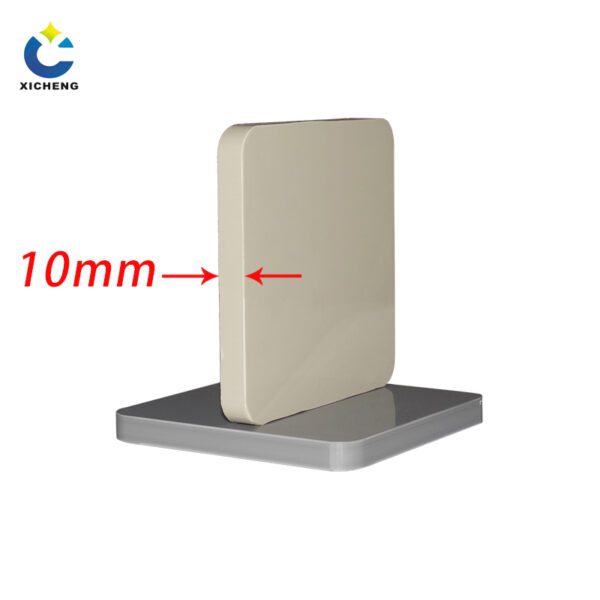
Table of Contents Toggle Product OverviewHow to Select the Right Thin Gauge — 3 mm vs 6 mm vs 10 mmWhy XichengCore AdvantagesKey SpecificationsThickness & Weight ReferenceMechanical Properties (All Gauges)Certifications and ComplianceHow to OrderComplete Your SystemFAQWhich thickness should I choose: 6 mm or 10 mm?Can 3 mm PP sheet be bent or thermoformed?Is 6 mm PP adequate for negative-pressure ductwork?Learn More on Our Blog Product Overview Thin PP sheet 3-10 mm — the light-gauge workhorse of industrial thermoplastic fabrication. At these thicknesses, PP is not self-supporting structural material (see thick PP sheet 10-25mm for that) but is the optimal choice for framed tank linings, duct panels, equipment covers, fume hood interiors, and formed components where a corrosion-resistant skin over a rigid frame provides adequate performance at the lowest material cost per square meter. Available in virgin PP homopolymer, 3 mm, 4 mm, 5 mm, 6 mm, 8 mm, and 10 mm thicknesses — ±0.2 mm tolerance, 5-point verified per sheet. Standard sheet sizes 1220×2440 mm (4×8 ft), 1500×3000 mm, and 2000×3000 mm. White, beige, and grey. The 6 mm thickness is the most commonly ordered gauge — the default for duct panel fabrication where stiffness-to-weight ratio at this thickness provides adequate span capability for typical ductwork support spacing. Material 100% virgin PP homopolymer — zero recycled or regrind. Lot-traceable resin Thicknesses 3 mm, 4 mm, 5 mm, 6 mm, 8 mm, 10 mm. ±0.2 mm tolerance. 5-point verified per sheet Sheet sizes 1220×2440 mm / 1500×3000 mm / 2000×3000 mm. Custom dimensions available Weight (1220×2440) 3mm: 8.0 kg | 4mm: 10.7 kg | 5mm: 13.4 kg | 6mm: 16.0 kg | 8mm: 21.4 kg | 10mm: 26.7 kg Temperature range -40°C to 90°C Colors White, Beige, Grey. Custom MOQ 500 kg Handling 3-6mm: one-person. 8-10mm: one-person (heavy) to two-person MOQ 1 m² — no minimum for standard thicknesses and colors Lead time 15-25 days How to Select the Right Thin Gauge — 3 mm vs 6 mm vs 10 mm Thin PP sheet from 3 to 10 mm spans a 3× thickness range — and the right choice depends on whether the sheet is a lining, a panel, or a semi-structural component. Selecting the wrong gauge wastes material or produces an underperforming part: 3-4 mm — the liner gauge. At this thickness, PP is a corrosion-resistant skin applied over a structural substrate. A 3 mm PP lining inside a steel tank provides full chemical isolation between the stored liquid and the steel wall — the steel carries the hydrostatic load, the PP prevents corrosion. 3 mm is also the preferred gauge for fume hood interior cladding — light enough to be adhesive-bonded or mechanically fastened to the hood structure, thick enough to resist chemical attack and accidental impact from glassware. At 8.0 kg per 1220×2440 sheet (3 mm), one person can handle and position panels on-site without lifting equipment. For applications demanding white surface for GMP visibility, see our white PP cleanroom sheet. 5-6 mm — the duct panel gauge. 6 mm PP is the industry-standard thickness for ventilation duct panels — and for good reason. At 16.0 kg per sheet, one person can handle it. At 6 mm thickness, a panel spanning 1 meter between flange supports has adequate stiffness under typical duct negative pressures (500-1,500 Pa) without excessive deflection. The flexural modulus of PP (~1,100 MPa) at 6 mm cross-section provides the stiffness-to-weight ratio that has made this the default duct fabrication gauge across the industrial ventilation industry for decades. Circular ducts at this thickness provide even better pressure resistance — the curved geometry converts pressure into hoop tension, where PP’s tensile strength (28-32 MPa) is fully utilized. For duct fabrication applications, see our PP round duct and PP square duct product pages. 8-10 mm — the semi-structural gauge. At 8-10 mm, thin PP transitions toward structural capability: 10 mm accepts M6-M8 tapped threads directly in the sheet for mounting pumps, instruments, and flanges without separate brackets. 8-10 mm is the standard for small chemical tank fabrication (up to ~2,000 liters with external steel frame) where the PP wall contributes to structural stiffness while the frame carries the primary hydrostatic load. The difference between 8 mm and 10 mm for a 2,000-liter tank is approximately 5 kg per sheet and about 15% more material cost — the engineering decision depends on the liquid specific gravity and the wall height. For tanks exceeding 2,000 liters or wall heights above 2 meters, see our thick PP sheet 10-25mm. For full-range general-purpose sheet, see PP polypropylene sheet 2-30mm. Material selection for chemical process equipment follows principles consistent with US EPA containment guidelines and EU Industrial Emissions Directive 2010/75/EU, both of which recognize non-metallic materials as a validated corrosion elimination strategy for equipment in continuous chemical contact service. Why Xicheng 16 years, 2600 systems shipped worldwide. Thin PP sheet is the highest-volume product in our extrusion operation — we produce more square meters of 3-10 mm sheet than all other gauges combined. The volume drives process refinement: Single-sheet handling — thin enough to be moved by one person. Every sheet from 3 mm (8.0 kg) to 6 mm (16.0 kg) is manageable by one fabricator without lifting equipment. This reduces the labor cost of every fabrication operation — cutting, edge preparation, positioning, welding — compared to heavier gauges. For fabrication shops handling dozens of sheets per day, the cumulative labor savings of one-person handling vs two-person handling is substantial over the course of a project. The 6 mm default — because it works, and has worked for decades. There is rarely an engineering reason to specify 5.5 mm or 6.5 mm PP for duct panels — 6 mm is the industry default because decades of fabricated duct installations have proven that 6 mm PP panels on standard support spacing perform reliably. We keep 6 mm PP in continuous production — it is almost always in stock or in the current extrusion schedule. Specify 6 mm and your order ships faster than any other gauge. Color-matched thin sheet for visible interior surfaces. Fume hood interiors, chemical cabinet linings, and equipment enclosure panels are visible surfaces — color consistency matters. Our thin sheet color palette (white/beige/grey) is spectrophotometer-monitored across production batches. A replacement panel ordered six months after the original installation will match. Contact [email protected] for color samples. Send your gauge, dimensions, and quantity to [email protected]. Quotation with batch availability within 24 hours. WhatsApp: 86 18927456906. Core Advantages 3× Gauge Range, One Material Platform: 3 mm liner through 10 mm semi-structural — one resin, one QC standard, one color palette across the full project. One-Person Handling (3-6 mm): 8.0-16.0 kg per sheet — fabricator can position, cut, and weld without lifting equipment or a second pair of hands. 6 mm Duct Standard — Continuous Production, Faster Delivery: The most commonly ordered gauge kept in near-continuous extrusion — typically the fastest-shipping thickness in our inventory. Spectrophotometer-Verified Color Across Batches: White/beige/grey matched for visible interior surfaces — replacement panels match original installations. Cost-Effective at Scale — Lightest Gauge, Lowest $/m²: Largest square-meter output per kilogram of resin — the most economical PP sheet option for framed and lined applications. Key Specifications Thickness & Weight Reference Thickness Weight (1220×2440) Weight (1500×3000) Handling Typical Application 3 mm 8.0 kg 12.3 kg One person Tank lining, fume hood cladding 4 mm 10.7 kg 16.4 kg One person Light cladding, equipment covers 5 mm 13.4 kg 20.5 kg One person Duct panels, cabinet bodies 6 mm 16.0 kg 24.6 kg One person Standard duct gauge, tank covers 8 mm 21.4 kg 32.8 kg One person (heavy) Small tank walls, structural panels 10 mm 26.7 kg 41.0 kg Two-person Tanks ≤2,000L, tapped-hole mounting Mechanical Properties (All Gauges) Material 100% Virgin PP Homopolymer Density 0.91-0.93 g/cm³ (ISO 1183) Tensile Strength 28-32 MPa (ISO 527) Flexural Strength 35-40 MPa (ISO 178) Impact Strength (Notched Izod) 3-5 KJ/m² (ISO 180) Heat Deflection Temperature 90-100°C (ISO 75) Working Temperature -40°C to 90°C Water Absorption < 0.01% (ISO 62) Flammability HB (UL 94). V0 FR grade available Colors White, Beige, Grey Certifications and Compliance CE Certified — Thin PP Sheet 3-10mm (3 certificates) RoHS Compliant — PP homopolymer ISO 9001:2015 — Quality Management System ISO 14001:2015 — Environmental Management System SGS Tested — Mechanical properties (tensile ISO 527, impact ISO 180, flexural ISO 178), dimensional accuracy (5-point measurement) Batch Weldability Verified — Test coupon pull-tested from each production batch (8 mm and 10 mm gauges) How to Order You send — Thickness (mm), sheet dimensions, color, quantity (sheets or m²), application (lining/duct/tank/cover/other) We confirm — Gauge availability and production schedule, pricing, lead time. 6 mm typically fastest-shipping We produce — Virgin PP extrusion, 5-point QC per sheet, spectrophotometer color check We ship — Wood pallet with moisture barrier. Sea freight (FOB Shenzhen), air, or land Contact [email protected] or WhatsApp 86 18927456906 — quotation within 24 hours. Complete Your System PP Polypropylene Sheet 2-30mm — Full thickness range Thick PP Sheet 10-25mm — Structural gauge for freestanding tanks PP Rigid Engineering Plate — Glossy precision plate PVC Rigid Plastic Sheet — Lower-cost alternative PP Round Duct — Ventilation ductwork PP PVC Welding Rod — Color-matched rod for sheet welding FAQ Which thickness should I choose: 6 mm or 10 mm? 6 mm is the standard for duct panels, tank covers, equipment cladding, and framed structures where the sheet is not the primary load-bearing element. 10 mm is the threshold where PP begins to contribute structural capacity: it accepts M6-M8 tapped threads, provides adequate wall strength for small framed tanks (≤2,000L), and offers measurably less deflection across equivalent spans. The cost difference is approximately 60% more material for 10 mm vs 6 mm. If you’re building ducts — choose 6 mm. If you’re building a tank — contact us for a thickness calculation. Can 3 mm PP sheet be bent or thermoformed? Yes. 3-5 mm PP sheet can be heat-bent along a line using a strip heater or hot air torch — a common technique for forming fume hood interior corners and chemical cabinet bodies. The bend radius should be at least 2× sheet thickness for 90° bends. Thicker gauges (6 mm ) require V-groove cutting before bending or full thermoforming with heated tooling. Is 6 mm PP adequate for negative-pressure ductwork? Yes — 6 mm PP duct panels on standard support spacing (1-1.5 m between flanges) adequately handle negative pressures up to approximately 1,500 Pa without excessive deflection. For spans exceeding 1.5 m, higher negative pressures, or rectangular ducts with large unsupported side dimensions, 8-10 mm may be required. Contact us with your duct cross-section and support spacing for a specific recommendation. Learn More on Our Blog PP vs Stainless vs FRP Material Comparison Wet Scrubber Technical Articles